Modeling slows our speech down. Modeling makes us pause.
Why is that an Aha! moment?
We are a work in progress as a family incorporating AAC into our lives. We have been on this journey for about six years now.
Modeling makes it easier for her to hear and understand what we are saying because we have to slow down.
We talk fast in this house. It is completely my fault. If you have something to say spit it out… right? That’s how I’ve been raised and influenced and I am having to undo all of that.
We also a butcher a few words. We tend to drop the G. Nothing personal to the language. It’s just a thing we do down here. But I can imagine how hard it is to decipher our back and forth bantering even when she is sitting right by our sides.
Adopting AAC modeling
It slows us down. It makes us pause. It gives her time to process. And it gives her more space to jump into our conversations. It means we are giving her a chance to join in and showing her we want to LISTEN.
If I am brutally honest with myself, I can admit it probably took a year, when she was 5ish, for us to really pick up on the fact that she was reading and listening to us. She had been so locked in her own world and messed up with seizure meds, we thought she might be deaf. She rarely looked up for her name, or when loud noises happened. It just didn’t matter to her. So I think sometimes, we are still working through building her confidence back up — confidence in us, to pay attention, to try to understand. And having to prove to her it’s worth her time to make the effort.
So even though we are putting communication boards on all the walls of the house, and I created a board for her doll, it’s all more functioning as gestures from us to show her we want to do better. We want to hear her and we want her to include us in her world.
A few more thoughts on this on the opening podcast episode. A lot of focus on listening right now and practicing mindfulness for myself.
I am full of reflection this time of year. On the heels of Epilepsy Awareness Month, while we approach a new year, I am grateful for three years of seizure freedom for my baby girl. I am grateful to a team of doctors, nurses, epileptologists, and neurosurgeons, and a dedicated Epilepsy Monitoring Unit and an amazing Child Life department, who all worked together so we could have these past six years of increasing independence and progress. I am grateful for our family’s health in spite of so much uncertainty. And while we remain cautious and vigilant, we also know there will be more good reasons to celebrate in our future.
A gift to myself
So, this year, I am allowing myself my own little celebration — the gift of dreaming.I am full of reflection this time of year. On the heels of Epilepsy Awareness Month, while we approach a new year, I am grateful for three years of seizure freedom for my baby girl. I am grateful to a team of doctors, nurses, epileptologists, and neurosurgeons, and a dedicated Epilepsy Monitoring Unit and an amazing Child Life department, who all worked together so we could have these past six years of increasing independence and progress.
I am grateful for our family’s health in spite of so much uncertainty. And while we remain cautious and vigilant, we also know there will be more good reasons to celebrate in our future. So, this year, I am allowing myself my own little celebration — the gift of dreaming.
I imagine a day where data tells me how my young adult daughter is doing. Ambitiously, I picture her driving on her own, maybe even living without me. (I know we don’t want them to drive too soon, but for many with epilepsy it’s much scarier and more complicated than just taking a driver’s test.) Only eight years old today, the same girl in my dreams, lives with a mix of daily life challenges, learning differences, and related health conditions, that tend to block these possibilities from entering my mind.
I dream of innovation for epilepsy
In my dream, some sort of amazing personal health innovation has made it possible for her, and her family, to not live in fear. That is the dream I sometimes allow myself to have. She is a complex care case, which presents many challenges. Like the 470,000 families in the U.S. with children diagnosed with epilepsy, there are so many obstacles our children face. So for many of us, we hesitate to dream. Our feelings are more tied to fear, anxiety and frustration for not having any way to control the disease, the beast that is epilepsy.
It’s hard to say exactly what would help my daughter live independently, but I believe a solution is out there. Consider all the progress in the past few years — we have personal health tracking devices, (AKA wearables, think Fitbits and Apple Health), connected cars with artificial intelligence, improved mobile app accessibility and adaptive tech advancements through voice command, all merging with how easy it is to access real-time data in the cloud. Yes, it is a mouthful, and it can make your head hurt sometimes, yet I believe these are the innovations we should follow. There will be a spark sometime soon, and then there will be a break-through for those living with epilepsy.
Why build a dream dependent on so much technology? I say why not?! If people with diabetes can have automated digital insulin pumps, and we can provide maternity care through a mobile sonogram, I have hope there is more for seizure monitoring and personal health management, as well.
How do we get there? Parents and patients are part of the future solution. We can even start now. We can continue the work already in progress by great organizations like The Epilepsy Foundation, End Epilepsy, and of course Mickie’s Miracles.
As parents, we can be part of supporting the research, enabling the advocacy and building the awareness for epilepsy.
Research
We can forge new paths for the ultimate patient experience by sharing research and having various health causes come together to amplify our collective voices.
For some, research starts with honing the questions we have, and picking a problem to solve. Ideally, research foundations and universities around the world will continue expanding how they incorporate advocates and patients into their studies. Researchers can better understand and analyze what it’s like living with the condition, even if seizures are managed with medication or implanted devices. Patient advocacy groups like WeGo Health and Patients Rising have formed just for this purpose. This is a great place for parents to connect — for focus groups and patient research studies — to learn, and maybe even participate.
There is so much potential when more minds come together. We can encourage joint research and study the unique connections between different health relationships, like metabolic disorders and epilepsy, genetics and epilepsy, and my personal focus, epilepsy and autism.
More than one study has found a higher likelihood of epilepsy in children presenting with autism spectrum disorder, and it is widely accepted that autism is more common in people with epilepsy. This kind of research raises unique questions — it also could harbor answers. New therapies and treatments may benefit thousands of children. Why not then dream for more coordinated solutions, more research and innovation?
Advocacy
Sharing our stories is a key part to advocating for help, and for getting answers. The more we put the details of our children’s lives into words, the more product developers, scientists and policy makers can understand what our epilepsy warriors need.
Advocacy is also expressing our observations as parents, what it feels like, and what it looks like. When we communicate our emotional and mental state, we are making it real for others. We want these innovators and researchers to think about how the medicine that blocks the seizures, also blocks our children’s words, and their thoughts. Or how days after a seizure, there are still lingering effects in lack of motor control or memory loss. It’s important to share how our family routines change and describe all the life hacks we have created to adapt the world for our children.
In my family, we worry when it’s hot outside because of dehydration being a trigger for seizures, so we avoid the park and outdoor sports. It’s a vicious cycle though, because then we worry our little one doesn’t get enough exercise. That has led us to create indoor exercise and sensory stations in our home. It’s not always practical in a traditional home setting, but we’ve made it work. Advocating can help other families see they are not alone in these unique situations. There are always multiple steps to think through, to solve these complex solutions. That is why it’s so important to share. It’s okay to need help. We want the innovation and research out there working to solve these problems with us.
Some parents may not feel they have anything to contribute that hasn’t already been said before. Maybe it’s best for some to start only sharing their stories with their immediate community. And that’s ok, too.
As parents of small children, we don’t yet know what our babies are feeling each day, but we can sense their fear or pain. We DO have important knowledge in treating our children. And that is how we are part of the solution. That is what we can share. Even when we think it’s been done before, it’s ok to share it again. In being part of a hospital system that believes in family-centered care, I have realized how powerful my voice is as a tool in my child’s care. I have learned to partner with our care team to be heard, and to practice active listening, so I can find the right moment to offer important details and observations and be part of the solution.
One last thought on our advocacy role as parents. Advocacy doesn’t start and stop with the medicine and the patient. It’s equally important to share what the life of the siblings can be like. Our empathetic brothers and sisters can be the best champions of the cause, but so many carry survivor guilt and feelings of abandonment that require mental health support. They don’t want to burden anyone, so they keep their feelings inside. These are all aspects of living with epilepsy and they all deserve to be heard.
Taken from Instagram account Andrea Mitchell
Awareness
When we bring the research and advocacy together, we turn it into powerful information and education. This is how we as parents can build awareness. I see this as a separate effort from directly advocating for your patient and family needs. When we share our stories, and build up a support network, we are mostly reaching our close circles. Awareness is about expanding the reach, and shining light on the stigmas and realities. Awareness requires openness and a lot of listening and patience.
This is when many parents may feel most comfortable by sharing the facts and the officially documented stories of others, rather than vulnerably putting their own concerns into the public. This is still a great way to start contributing to making change happen. We can all explain how our child is that 1 in 26 that the research has calculated. We can choose whatever statistic or story that describes our situation, and make it our drum beat.
We can each participate in a way that suits our family at that time. My family has strolled and stomped through the zoo. We have had fun at galas and fundraisers, and we have made personal videos of our pain and our celebrations. Some years, we just can’t do any more than post the facts. It’s all ok, and it’s all building awareness.
As parents, we can feel hopeless or lost through this journey. We can feel completely worthless, not being able to protect our child. We can feel anger and frustration because we can’t find the answers. We don’t have to do it alone. And the reality is, the more we share and let others in, the more likely we are going to get to be part of the solution.
Why not dream for a better life for our children, and let the research, advocacy and awareness come together to spark that innovation. I say why not dream big?
AGREED OR NOT, LET’S DISCUSS. If not here, you can also find me on Instagram. Viz.able
I choose to find the wins in our world. To reach for light even when we are surrounded in darkness. Sometimes, it’s a quick pick-me-up to revel in a sweet success, no matter how small.
Reflecting on things to celebrate — March 2020 — I will watch this 100 hundred times! This was a surprise she brought me herself. She wanted me to see she had learned this from therapy. I had no idea! 💜
Eight years ago, we noticed these long, slender fingers immediately.
My mom said “look at the piano player.” I think about that now and then. These fingers have struggled to lay flat for crawling. They have grabbed me in fear of another seizure coming. They have fought a coordinated effort to grip a fork. And they just recently started taking proper orders for pointing and counting. 💜
These graceful fingers, even though they can sign a couple words and they can use scissors to cut paper like a champ, they don’t work well in opposite activities. They ignore orders, or maybe they just don’t always get the signal from the Comander in Chief Brain.
So today, we celebrate the battle over buttons. Pesky, resistant little boogers, these glittery opponents lost to this mighty troop of fingers, who have rallied together to seize the day. And maybe, just maybe, piano keys are still a future battle to be fought and won. ☺️🎹
Learning how to use AAC is what keeps me up at night, or rather haunts me in my sleep. Yes, we already have some battle scars from brain surgery, and set backs from hospitalizing seizures. 💜
I worry what makes her most vulnerable is not having a voice people can understand. — I’ve dreamt I’m fighting a pack of wolves off coming near my baby girl. I’ve dreamt of smoke taking our breath and I wake up gasping.
This is obviously my psyche dealing with the very deeply rooted survival mindset of a mama bear protecting her young. It’s not a light-hearted moniker. It’s a serious state of mind.
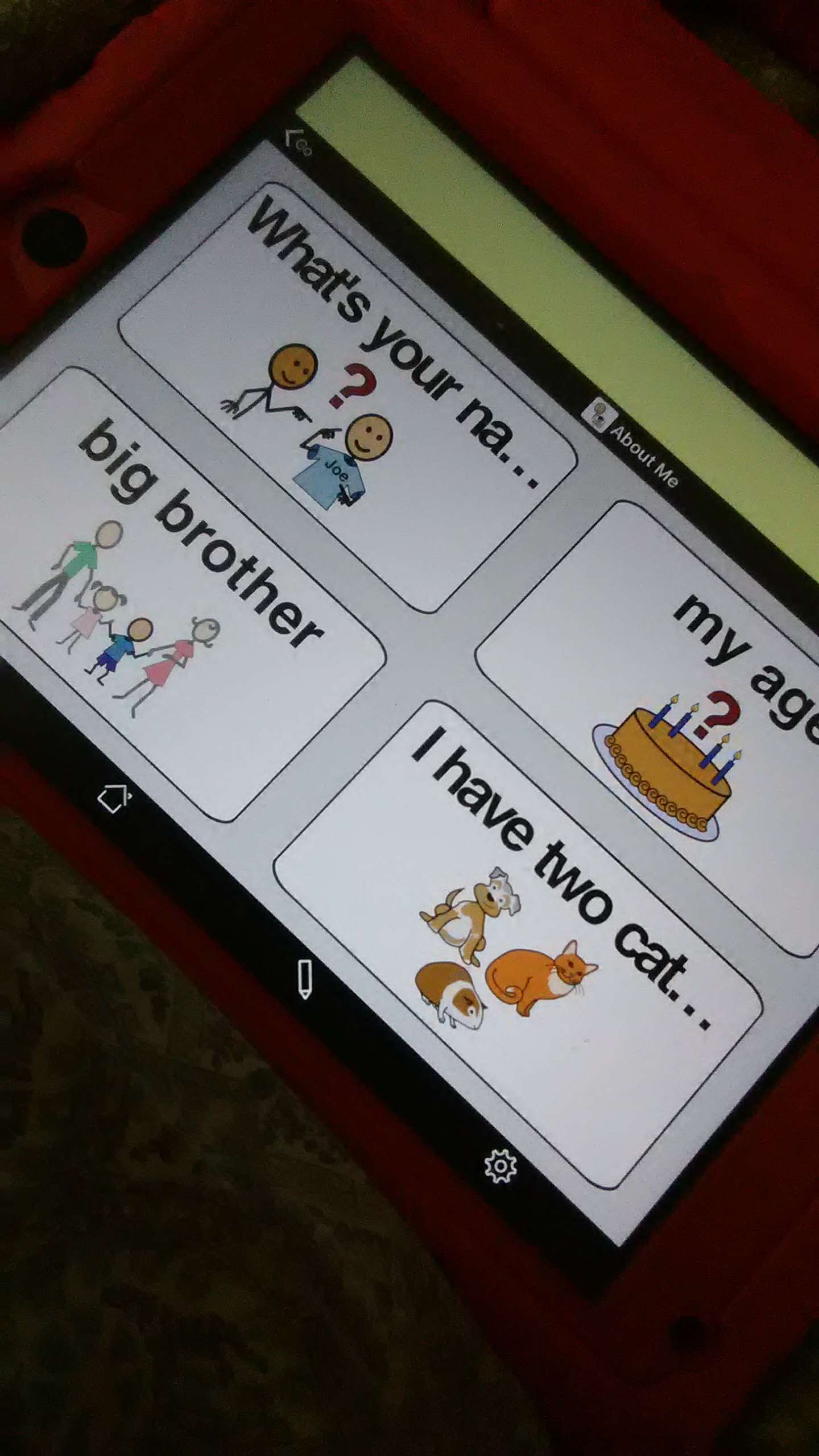
So, now that I’ve had a little time to assess her needs in our current surroundings, and consider her progress, I’m set on focusing all our efforts on her AAC, the iPad we fondly call her talker. Your thoughts are welcome on this one.
This world can be so hard to face some days — especially when you’re the mom of a little girl, and maybe more importantly of a boy who you want to appreciate and respect and celebrate girls, too.
I admit I never worried too much about my looks. I had enough self confidence to get me through the rough years, and in the moments when I looked in the mirror and didn’t like what I saw, I think the love and friendships I felt overshadowed it. I get that most women didn’t have that experience though. And even harder to admit, it’s become a bigger challenge as I’ve watched this face collect more lines and freckles and fight the inevitable gravitational pull.
So it is now that I am grateful for a wise woman giving me a piece of motherly advice three years ago as I looked displeasingly at my post-partum shape in a hotel lobby bathroom.
“Stop that!” she said. You have a daughter now. You can’t let her see you sigh and fidget like that. When you have teenage daughters, you realize they pick up on everything you do. Especially how you react to your own reflection.
My tried and true body soap, Dove, still continues to challenge and encourage us all and I am grateful for their courage in a very callous marketing world. Don’t miss their latest viral video and please be sure to share it.


 OK With Change